Precio Und.
22,25€
Don Quixote de la mancha
Editorial
Penn State Press
Penn State Press
Ilustración
Roberto Weil
Roberto Weil
Idioma
Inglés
Inglés
Encuadernación
Tapa blanda
Tapa blanda
Páginas
128
128
Dimensiones
26,50 x 21,50
26,50 x 21,50
Edición
2018
2018
Idioma original
Castellano antiguo,
Castellano antiguo,
Traducción
Ilan Stavans
Ilan Stavans
ISBN
9780271082318
9780271082318
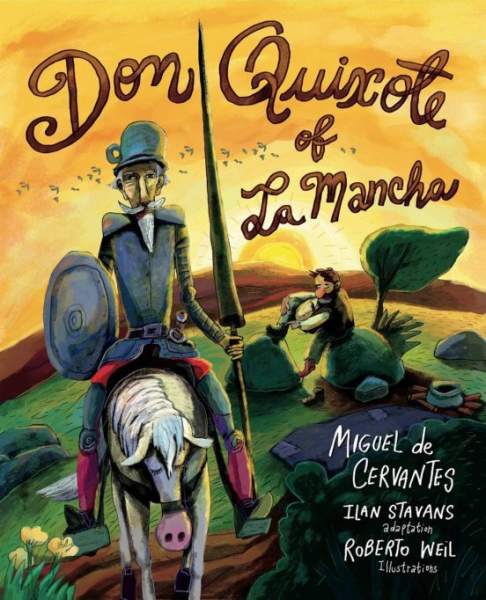
Originally published in two parts in 1605 and 1615 and often considered "the first modern novel," Miguel de Cervantes's Don Quixote is undoubtedly the most influential work in the Spanish literary canon. In this groundbreaking graphic adaptation, cultural commentator Ilan Stavans and illustrator Roberto Weil reimagine Cervantes's masterpiece in ways that are both faithful and whimsically irreverent. In these pages, Stavans and Weil pay tribute to Cervantes's novel as well as its complex resonances in the centuries since its publication. The dauntless "mad knight" Don Quixote and his hapless squire, Sancho Panza, encounter the infamous windmills, contend with disbelieving peasants and noblemen, and seek relentlessly for Quixote's imaginary love, Dulcinea. They also confront their own creators and adapters--Cervantes, Salvador Dal , Franz Kafka, and Stavans and Weil themselves--and try to make sense out of the madness of drones, taxicabs, and their own literary immortality. The result is an ambitious and compelling graphic novel that reveals Don Quixote as un libro infinito--a work that reflects the past, present, and future of the human condition. Available in both English and Spanglish editions, this inspired and audacious interpretation of one of the greatest novels ever written is sure to be savored by generations to come.
ILAN STAVANS
Is Lewis-Sebring Professor of Humanities and Latín American and Latino Culture at Amherst College, the publisher of Restless Books, the host of New England Public Radio’s “In contrast” and a columnist for the Spanish edition of the New York Times. He is the author of Quixote: The Novel and the World and coauthor of Once@9:53am, the latter also published by Penn State University Press
ILAN STAVANS
Is Lewis-Sebring Professor of Humanities and Latín American and Latino Culture at Amherst College, the publisher of Restless Books, the host of New England Public Radio’s “In contrast” and a columnist for the Spanish edition of the New York Times. He is the author of Quixote: The Novel and the World and coauthor of Once@9:53am, the latter also published by Penn State University Press
Miguel de Cervantes
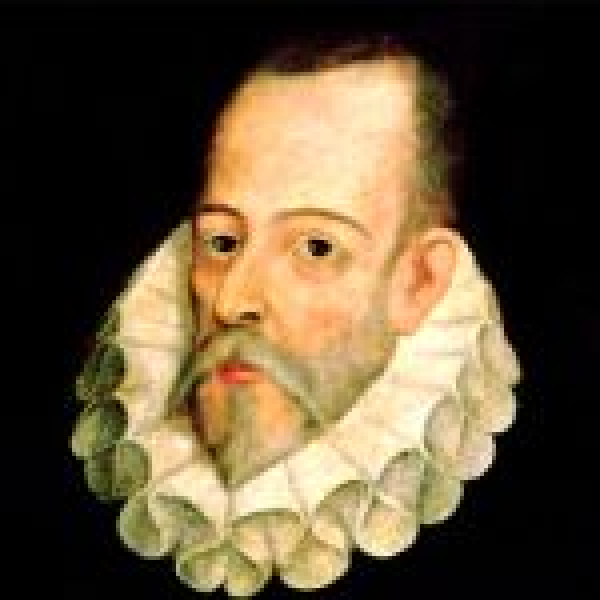
Alcalá de Henares, (1547-1616). Miguel de Cervantes vivió una infancia y juventud marcada por los acuciantes problemas económicos de su familia, lo que marcó que su formación intelectual fuera más bien autodidacta. Su participación en la batalla de Lepanto le provocó la pérdida de su mano izquierda. Tras la publicación de su obra La Galatea, trabajó como comisario real de abastos, lo que le permitió acercarse al pintoresco mundo del campo, que tan bien plasmó en su obra El Quijote, obra cumbre de las letras hispanas, cuya publicación, si bien exitosa, no sirvió para sacarle de la pobreza. La grandeza inmensa de El Quijote no oculta, sin embargo, el enorme valor del resto de la producción literaria de Cervantes, que abarca también el género poético.
Roberto Weil
Is an award-winning ilustrator living in Miami. He collaborated with Ilan Stavans in The graphic novel “Mister Spic Goes to Washington”.